
What Stories Can Show Us About Ourselves
A friend recently mentioned me on her podcast because of a book recommendation I shared that handled a question she’s been trying to answer for herself. What stayed with me wasn’t that she enjoyed the book. It was that she was still thinking about the question the story explored.
That’s the amazing thing about books, especially even popular fiction. The story can keep working on us long after you finish reading it. And it reminded me of something I’ve been noticing. Stories often help us see things that are difficult to see directly.
The Gift of Distance
Most of us spend our days immersed in our own lives (or the technology that sucks us in). We’re inside the relationships, the challenges, and responsibilities. And we’re inside the questions we’re trying to answer about ourselves, our stories, and the path we are on.
When we’re living something, it can be difficult to see it clearly. Not because we're incapable, but because we’re too close. Stories create distance. Not distance from caring, but distance from immersion. And sometimes that distance changes everything.
A character makes a choice we would never make. Someone responds to a challenge differently than we would. A story introduces a possibility we hadn’t considered, it makes something possible for ourselves because we’re aware of that option. Suddenly we are observing rather than living. And observation often reveals things that immersion cannot.
Why Certain Stories Stay With Us
Most books are forgotten, but some stay with us for years. I’ve started wondering if the stories that stay with us aren’t necessarily the ones with the best plots. They are the ones that illuminate something.
They give language to a question we didn't know we were carrying. They reveal an assumption we didn't know we were making or challenge a belief we’ve never thought to question. They offer a different way of seeing. Not because they tell us what to think, but because they help us notice something and makes it possible to name it.
Stories as Orientation Tools
Most people think stories are entertainment. I’ve started wondering if they’re also orientation tools. A good story can help us explore possibilities without the consequences of living them. It allows us to experience perspectives we might otherwise never encounter. They also create enough distance for reflection and enough safety for curiosity. Enough perspective to notice what resonates and what doesn’t.
In that sense, stories become a form of observation. Not observation of the characters but as observation of ourselves.
What draws our attention?
What frustrates us?
What inspires us?
What feels familiar?
What feels impossible?
Our reactions often reveal as much as the story itself.
What Are You Really Reading?
The next time a book stays with you, consider a different question. Instead of asking- “What happened in the story?” Try asking yourself “What did this story help me notice?” Perhaps it highlighted a possibility you hadn’t considered or challenged an assumption you’ve held (or limited yourself by). Perhaps it revealed a longing or almost magically gave language to something you were already experiencing.
Perhaps it simply helped you see yourself more clearly. Because sometimes the most important story isn’t the one happening on the page… it’s the one the page helps us recognize in ourselves.
A Different Way to Read
One thing I’ve noticed is that stories become even more powerful when we use them as mirrors instead of merely entertainment. Not because every book contains a lesson for us or a story to unravel within ourselves. But because every story offers an opportunity to observe. To notice, reflect and maybe actually see.
And sometimes a different way of seeing is exactly what creates orientation to help us navigate our own life.
A Question to Consider
Think about a book that made you feel something in the moment or stayed with you long after you finished it. What did it help you notice? Contemplate it through the lens of what it helped you notice about yourself, your relationships, your work. Notice what it made you think or reconsider about your life.
I’m curious what becomes visible when you look at it through that lens.
Continue Exploring
If you enjoy using stories as a way to better understand yourself and your experience, you might enjoy the Story Shift Guide.
It’s a collection of prompts designed to help you use books, movies, and stories as lenses for observation, reflection, and self-discovery.
Because sometimes the stories that change us aren’t teaching us what to think… they’re helping us see what was already there.
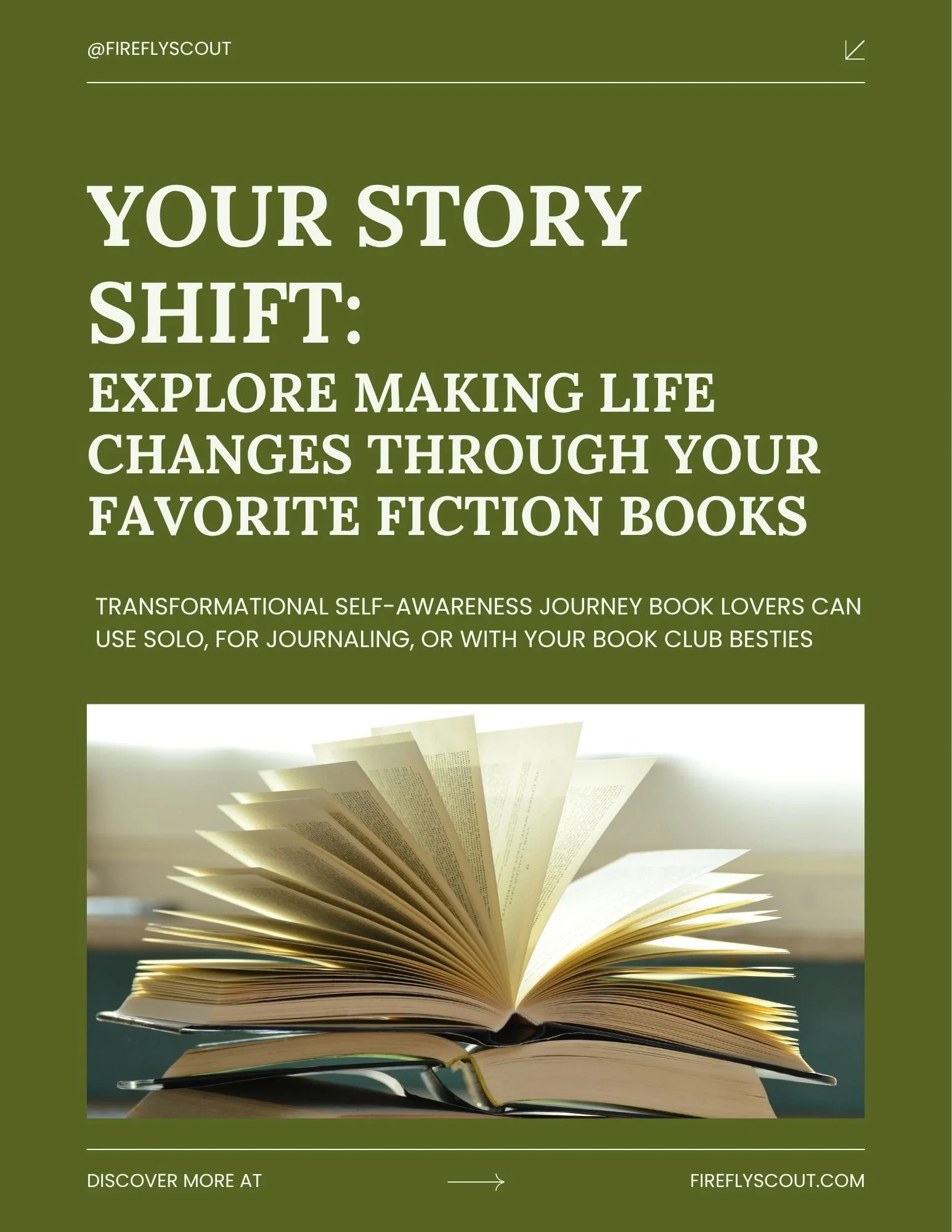
A gentle companion for moments of self-inquiry.
Story Shift is a gentle, self-paced reflection guide for people who love books — and who sense that the stories they’re drawn to are often mirroring something in their own lives.
Rather than helping you “rewrite” your life or force a new narrative, Story Shift invites you to notice the stories you’re already living: the assumptions you’ve absorbed, the roles you’ve outgrown, and the patterns that quietly shape your choices.
Using thoughtful prompts and guided reflection, this printable workbook helps you:
notice the narratives influencing your reactions and decisions
understand where certain stories first took shape
distinguish between stories that protect you and ones that limit you
explore alternative perspectives without pressure to change
create space for new choices to emerge naturally
Story Shift isn’t about mindset fixes or positive thinking. It’s about learning how to relate differently to your inner stories, with curiosity, clarity, and self-trust.
You can move through the prompts slowly, revisit sections when familiar patterns resurface, or use it as a companion during moments of transition or reflection. There’s no right way to use this guide, your experience is the guide.
This reflection tends to resonate most with thoughtful, self-aware readers who enjoy using stories as mirrors and want insight that honors complexity rather than simplifying it away.
Instant digital download • Self-paced • Return to it anytime

Stephanie Rose is the founder of Firefly Scout and creator of the Human Orientation framework. Through observation, pattern recognition, and self-authorship, she helps people become more accurate interpreters of themselves and their lives so they can navigate change, growth, and "all the things" with greater clarity, capacity, and self-trust.
If you enjoy exploring a different way of seeing, join the Firefly Scout newsletter or download the free Observation Snapshot to start noticing what your life may already be trying to show you.
Related reading

Even beach reads can give language to a question we didn't know we were carrying.